Este sitio web utiliza cookies para su correcto funcionamiento, así como para mejorar la visibilidad de nuestros productos, tal como explicamos en nuestra
política de cookies. No usamos cookies de publicidad, así que no vas a ver anuncios aquí. Por favor, acepte las cookies que utilizamos o configúralas a tu medida.
Selecciona aquellas cookies que quieres inhabilitar. Las cookies necesarias no se pueden desactivar porque son imprescindibles para el buen funcionamiento del sitio web.
+ Info
Irish Ferries
Irish Ferries
Irish Ferries: Ireland's leading ferry operator, since 1973
❤︎Irish Ferries is Ireland's foremost ferry company, with over 50 years of connecting the Emerald Isle with Great Britain and mainland Europe. Its origins lie with Irish Continental Line, founded in 1973 as a joint venture between Irish Shipping, Fearnley & Eger and Sweden's Lion Ferry, with its inaugural route between Rosslare and Le Havre. Following the liquidation of Irish Shipping in 1984 and the subsequent acquisition of the B&I Line in 1992 — which brought with it the historic Dublin–Holyhead and Rosslare–Pembroke services — the company evolved into the current Irish Continental Group (ICG), listed on both the Dublin and London stock exchanges. Irish Ferries is today its passenger ferry division, with a fleet of eight modern vessels and a cumulative investment of over €450 million in fleet and port facilities. In 2021 it expanded its network with a new Dover–Calais route, becoming the only Irish operator with a service on the English Channel.
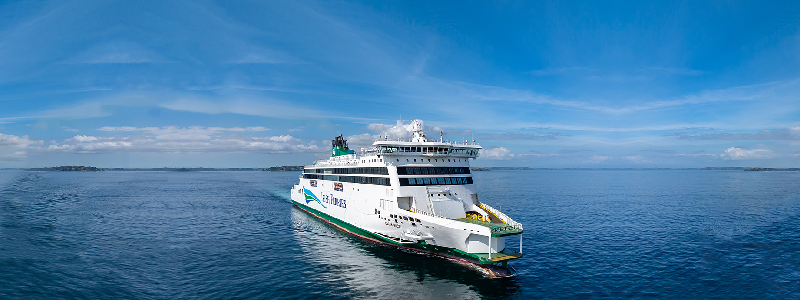
The Oscar Wilde fast ferry, one of the most capable vessels on the Irish Sea with room for over 2,000 passengers and more than 1,000 vehicles.
Irish Ferries at a glance
Founded: 1973 (Irish Continental Line) → Irish Continental Group (ICG) from 1984
Headquarters: Dublin, Ireland
Parent group: Irish Continental Group (ICG) — listed on the Irish Stock Exchange and London Stock Exchange
Fleet investment: over €450 million in vessels and port facilities
Fleet: 8 vessels (cruise ferries, fast craft and ro-pax)
Active routes: Dublin–Holyhead · Rosslare–Pembroke · Dublin–Cherbourg · Dover–Calais
Maximum frequency: up to 20 daily sailings on Dover–Calais; up to 4 daily on Dublin–Holyhead
Flagship vessel: MV Ulysses (2001) — largest ROPAX on the Irish Sea; was the world's largest car ferry at launch
Newest vessel: MV James Joyce (acquired in full ownership in 2025) — the largest and fastest on the Irish Sea; 2,000+ passengers, 2,380 lane metres, 27.5 knots
Only fast craft on the Irish Sea: Dublin Swift (Holyhead–Dublin in ~1h 49min)
Loyalty programme: Club Sea Saving (points redeemable against future bookings)
Wi-Fi on board: complimentary on all vessels
No e-ticket: booking confirmation (printed or on your phone) presented at the port ticket office to collect boarding card
Irish Ferries routes and timetables
Irish Ferries operates four regular routes: two on the Irish Sea, one to France and one on the English Channel. The Irish routes run year-round, as does the connection to Cherbourg. The English Channel service runs at high frequency throughout the year.
Important: Irish Ferries does not issue e-tickets. You must present your booking confirmation (printed or on your phone) at the port ticket office to collect your boarding card. On the Dover–Calais route, border controls take place after check-in: allow sufficient time for both procedures. Minimum check-in: coach passengers 1h before · vehicle and foot passengers 30 min before.
Irish Ferries top routes
Each Irish Ferries route has its own character: from the express crossings of the English Channel to the overnight Atlantic voyage between Dublin and Cherbourg, via the historic Irish Sea connection linking the Irish capital with Wales. Below are the company's most important services:
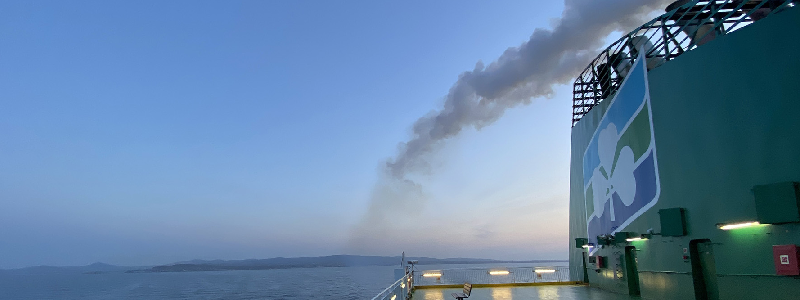
The Irish Sea seen from the deck on the Dublin–Holyhead route, Irish Ferries' busiest connection with up to four sailings a day in each direction.
Irish Ferries' most important route: it connects the Irish capital with the Welsh port of Holyhead (north Wales) in ~3h 15min on the large conventional vessels, or in just ~1h 49min on the Dublin Swift, the only fast craft on the Irish Sea. With up to four sailings a day in each direction and operated by the three most iconic vessels in the fleet (Ulysses, James Joyce and Dublin Swift), it is the cornerstone of the Irish Ferries business. The Ulysses, with its twin-screen cinema and James Joyce themed trail, turns the voyage into a cultural experience. The new James Joyce (introduced in May 2025) is the largest and fastest cruise ferry on the Irish Sea: 2,000+ passengers, 2,380 lane metres and 27.5 knots.
Duration: ~3h 15min (conventional) / ~1h 49min (Swift) · Frequency: up to 4 daily sailings · Year-round
Irish Ferries' great ocean crossing: it links Ireland directly with Normandy in ~18h30–19h without touching the United Kingdom. Operated year-round by the award-winning W.B. Yeats (Ferry Concept Award 2019), it is the preferred choice for families driving to Ireland from the Continent, as well as for travellers from Spain, Portugal or the south of France. The long crossing becomes a short cruise, complete with cabins, restaurants, a late-night bar and a generous outdoor deck area.
Irish Ferries' most frequent route, launched in June 2021: it crosses the English Channel in just 90 minutes with up to 20 daily sailings, operated by three vessels on continuous rotation (Isle of Inishmore, Isle of Innisfree and Isle of Inisheer). It is the only Irish Ferries route that does not touch Irish soil, and provides an Irish alternative on Europe's busiest crossing. At Calais, border controls are carried out after check-in, so allow sufficient time for both procedures.
Duration: ~1h 30min · Frequency: up to 20 daily sailings · Year-round
The historic connection between the south of Ireland and the south of Wales: it links Rosslare Europort (County Wexford) with Pembroke Dock in approximately 4 hours, with two sailings a day. It is the ideal route for travellers wishing to reach Cork, Waterford, the south-east of Ireland or the capital itself from south Wales or the south-west of England. Operated by the Isle of Innisfree and the new James Joyce, it includes cabin options for overnight crossings.
Irish Ferries operates eight vessels across its four routes. The fleet combines large ro-pax cruise ferries (Ulysses, W.B. Yeats, James Joyce), medium-sized vessels for the English Channel (the Isle of Inis- series) and the only fast craft on the Irish Sea (Dublin Swift). A cumulative investment of over €450 million has made this one of the most modern fleets in Western Europe. All vessels bear the names of great Irish literary figures or references: Ulysses (James Joyce), W.B. Yeats, Dublin Swift (Jonathan Swift), James Joyce…
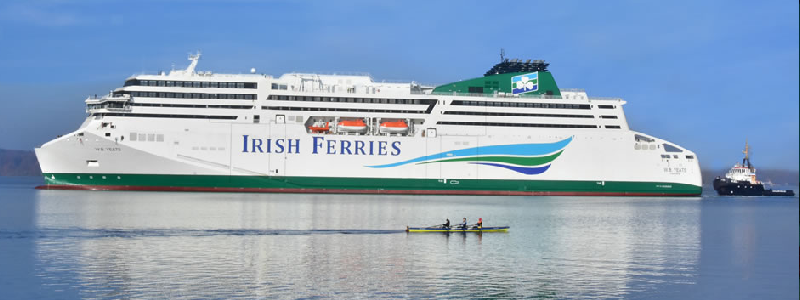
The MV W.B. Yeats, winner of the Ferry Concept Award and Interior Architecture Award at the 2019 Shippax Industry Awards, operates the Dublin–Cherbourg route year-round.
On-board services (cruise ferries: Ulysses, W.B. Yeats, James Joyce)
Restaurants and brasseries: full table-service with à la carte menus and self-service options on all large vessels
Cafeterias and bars: bars, cafés and late-night bars; snack bar available for shorter crossings
Club Class (exclusive lounge): access to the premium zone with greater comfort and personalised service; upgrade available from £22 per passenger
Shops and duty-free: extensive retail area with fashion, perfumery, gifts, souvenirs and electronics on board
Complimentary Wi-Fi: available on all vessels throughout the crossing
Entertainment zones / TV lounges: televisions in rest areas; entertainment zones throughout the vessel
On-board cinema (Ulysses): twin-screen cinema; the only vessel on the Irish Sea with this facility
Children's play area: dedicated space for younger passengers
Outdoor terrace: open deck for enjoying the views
Cabins: interior and exterior options; suites available on some vessels; pet-friendly cabins on selected routes
Freight Drivers' Club: exclusive area for lorry and freight drivers (James Joyce)
Accessibility (reduced mobility): fully equipped cabins for passengers with reduced mobility and special requirements; assistance at embarkation/disembarkation on request at least 2 days in advance
On-board services (Dover–Calais: Isle of Inis- series)
Cafeterias and bars: light catering options suited to the short crossing duration (90 minutes)
On-board shop: travel items and everyday products
Wi-Fi on board: also available on these vessels
Styled cabins (Isle of Inishmore): cabins in a more relaxed setting; option of additional privacy
Irish Ferries featured vessels
The Irish Ferries fleet is one of the most modern and best-regarded on Europe's Atlantic routes. Its vessels bear the names of Ireland's foremost literary figures: the Ulysses (after the James Joyce novel), the W.B. Yeats (after the Nobel Prize-winning poet), the Dublin Swift (after Jonathan Swift, author of Gulliver's Travels), and the James Joyce himself. The English Channel vessels, in turn, are named after the Aran Islands, off the west coast of Ireland.
MV Ulysses (2001)
The Irish Ferries flagship, built at the Flensburger shipyard in Germany and launched in 2001. It is currently the largest active ROPAX ferry on the Irish Sea and was the world's largest car ferry at the time of its launch: capacity for over 2,000 passengers and 1,342 vehicles (more than 4,100 lane metres of garage space). Recognised with the 'Most Significant Newbuild – Ferry' award by Lloyd's List in 2001. The only Irish Sea vessel with a twin-screen cinema and a pedestrian trail themed around James Joyce's novel Ulysses. Operates primarily on Dublin–Holyhead.
MV James Joyce (2007 / acquired 2025)
The largest and fastest vessel on the Irish Sea since its permanent entry into the fleet in May 2025. Built in 2007 at the same Finnish shipyard as the Ulysses, it was purchased outright by Irish Ferries that year (previously operated on charter as Tallink's Star 1). Capacity for over 2,000 passengers, 2,380 lane metres of garage space and a top speed of 27.5 knots. Features a Club Class lounge, Freight Drivers' Club, restaurants, a retail area and cabins. Operates on Dublin–Holyhead alongside the Ulysses.
MV W.B. Yeats (2018)
The most recent vessel purpose-built for Irish Ferries, delivered by the Flensburger shipyard in December 2018 with its maiden commercial voyage in January 2019. Named after the Irish poet and Nobel laureate W.B. Yeats via an online competition. Winner of the Ferry Concept Award and the Interior Architecture Award at the 2019 Shippax Industry Awards. Exclusively serves the year-round Dublin–Cherbourg route, with capacity for over 2,000 passengers, cabins, restaurants, bars, a retail area and an outdoor terrace.
Dublin Swift (fast craft)
The only fast craft on the Irish Sea, successor to the legendary HSC Jonathan Swift (in service until 2018). With the Dublin Swift, Irish Ferries offers the fastest option on the Holyhead–Dublin route: approximately 1h 49min from Holyhead and ~2h 15min towards Holyhead, compared to ~3h 15min on the conventional vessels. It operates a limited number of daily sailings, so advance booking is recommended, particularly during the high season. Ideal for business travellers or those wishing to minimise crossing time.
Irish Ferries ports
Irish Ferries operates from six ports across Ireland, Wales, England and France. Dublin is the company's central hub, while Holyhead is the main port of entry to Ireland from Wales.
Irish Ferries applies a tiered pricing structure in which the first passenger and vehicle form the base fare and additional passengers receive a reduced rate, making family travel proportionally more economical as the number of passengers per vehicle increases. The company also offers the following verified discounts and benefits:
Eurail Pass holders: −30% on standard foot passenger fares (adult or child); booking is compulsory by sending the reference number and the pass cover number to bookings@irishferries.com to receive the refund
Club Sea Saving (loyalty programme): points earned on every trip, redeemable immediately against your next booking; direct management of the programme requires contacting Irish Ferries
Club Class upgrade: access to the exclusive lounge from £22 per passenger on vessels that offer it
Tesco Clubcard Points (UK market): points can be used as full or partial payment for tickets on irishferries.com
Rail & Sail: combined rail + ferry package from £46, ideal for foot passengers arriving by train at embarkation ports
Seasonal offers: discounts of up to 25–50% on passages, cabins, vehicles and pets during lower-demand periods; check irishferries.com or when booking on iloveferry.com
Free pets (periodic promotion): a recurring promotion allowing passengers to bring pets at no extra charge; available on certain seasons and routes
Gift vouchers: gift cards from £25 redeemable on any route and date
Note: Irish Ferries does not offer systematic general discounts by age (children, students) or for families. Available discounts are shown during the online booking process based on route, date and availability. Booking in advance is recommended to access the best fares.
Accommodation and travel classes
The accommodation offering on Irish Ferries varies by vessel and route. The large cruise ferries (Ulysses, W.B. Yeats, James Joyce) provide the most comprehensive range; the English Channel vessels (Isle of Inis- series) offer a lighter selection in keeping with their 90-minute crossing:
Lounge seat (standard): reclining seat in an air-conditioned lounge with access to all shared facilities on board; the most economical option on all routes
Club Class: exclusive lounge with greater space, superior comfort and personalised service; upgrade available from £22 per passenger on the Ulysses, W.B. Yeats and James Joyce
Interior cabin: windowless cabin in the central part of the vessel; includes bunk beds or a double bed, a key lock and private facilities; ideal for overnight crossings (Dublin–Cherbourg) or passengers who need to rest
Exterior cabin: cabin with a window or porthole; same facilities as the interior cabin but with natural light; available on all three large vessels
Accessible cabin (reduced mobility): fully equipped for passengers with reduced mobility or special requirements; informing the operator at least 2 days before embarkation is recommended
Pet-friendly cabin: available on selected routes for passengers travelling with pets in their vehicle; allows access to the pet during the crossing
Suites (some vessels): superior accommodation with more space and premium furnishings; available on the W.B. Yeats and other vessels in the fleet
Cabins must always be booked in advance, particularly during the high season (July–August) and on the Dublin–Cherbourg route, where they sell out quickly. Irish Ferries does not issue e-tickets: the booking confirmation (printed or on your phone) is presented at the port ticket office to collect a physical boarding card.
Luggage, vehicles and pets
Luggage
Foot passengers may bring luggage of up to 22 kg per item. On the Dublin–Holyhead route, checked luggage is deposited on a carousel during boarding and collected at the destination terminal; it cannot be accessed during the crossing. On the Rosslare–Pembroke route, foot passengers carry their luggage on the shuttle bus between the ship and the terminal. Passengers with a vehicle may bring additional luggage, although all belongings must remain inside the vehicle during the crossing. Precise limits vary by route and ticket type.
Vehicles
Irish Ferries accepts cars, motorbikes, bicycles, motorhomes and freight vehicles on most of its routes (7 of the 8 vessels have a vehicle deck; the Dublin Swift also accepts vehicles). It is not possible to send an unaccompanied vehicle. For cars, motorhomes and lorries, prices and availability must be checked during booking by providing the exact dimensions of the vehicle. During the high season (July–August), booking vehicle space as far in advance as possible is strongly recommended to secure a place.
Pets
Irish Ferries accepts pets (dogs, cats and ferrets) on all its Irish routes via two options: reserved kennels on board — owners may visit their pet at fixed times accompanied by a crew member — or leaving the pet in their own vehicle during the crossing. Please note: kennels are not available on the Dover–Calais route, which means foot passengers cannot travel with pets on that service. Guide dogs and assistance dogs are always permitted on all routes without restriction. Booking a kennel in advance is advisable as spaces are limited.
Required documentation
Non-British and non-Irish nationals require a valid passport to enter Ireland. British or Irish citizens may travel between the two countries using an alternative identity document (driving licence, international student card, etc.), although carrying a passport is always recommended. A valid passport is required for all passengers on the Dover–Calais route. Spanish and EU citizens travelling to Ireland do not require a visa. Pets must carry a European pet passport, microchip and up-to-date rabies vaccination; it is advisable to verify the specific entry requirements for your destination before travelling.
High season (July–August): Irish Ferries experiences very high demand on its Irish Sea routes, particularly for passengers with vehicles. Booking tickets and cabins several months in advance is strongly recommended. On the Dublin–Cherbourg route, cabins are the first to sell out. Booking early also provides access to lower fares.
How to book Irish Ferries sailings on iloveferry.com
Select your departure and destination port (Dublin, Holyhead, Rosslare, Pembroke, Dover, Calais or Cherbourg).
Choose the date and compare timetables, vessel types (Swift or conventional) and available prices.
Enter the number of passengers and add your vehicle and/or pet if required.
Select your travel class: standard seat, Club Class, interior/exterior cabin or pet-friendly cabin.
Complete payment and save your booking confirmation. Present it at the port ticket office on the day of travel to collect your boarding card.
Irish Ferries operates four main routes: Dublin–Holyhead (Irish Sea, ~3h 15min, up to 4 daily sailings), Rosslare–Pembroke (~4h, 2 daily sailings), Dublin–Cherbourg (France, ~18h30–19h, 4–5 crossings per week year-round) and Dover–Calais (English Channel, ~1h 30min, up to 20 daily sailings). It is Ireland's leading ferry company and operates between Ireland, Wales, England and mainland France.
Can I take pets on Irish Ferries?
Yes. Irish Ferries accepts pets (dogs, cats and ferrets) on all its Irish routes. There are two options: reserved kennels on board (owners may visit their pet at fixed times accompanied by a crew member) or leaving the pet in your own vehicle during the crossing. Important: kennels are not available on the Dover–Calais route, which means foot passengers cannot travel with pets on that route. Guide dogs and assistance dogs are always permitted. It is advisable to book a kennel in advance.
What is the Irish Ferries flagship vessel?
The Irish Ferries flagship is the MV Ulysses, launched in 2001 at the Flensburger shipyard in Germany. It is currently the largest active ROPAX ferry on the Irish Sea and was the world's largest car ferry at the time of its launch, with capacity for over 2,000 passengers and 1,342 vehicles (more than 4,100 lane metres of garage space). It operates primarily on the Dublin–Holyhead route and features a twin-screen cinema, a James Joyce themed trail and extensive catering facilities.
How far in advance should I arrive to board an Irish Ferries sailing?
Irish Ferries check-in times vary according to passenger type: coach travellers must check in at least 1 hour before departure; vehicle passengers (car, motorbike, motorhome) and foot passengers or cyclists must be at the port at least 30 minutes before departure. During the high season, arriving with additional time is recommended. There is no e-ticket: you present your booking confirmation (printed or on your phone) at the port ticket office to collect your boarding card. At Calais, border controls take place after check-in, so allow sufficient time for both procedures.
What discounts does Irish Ferries offer?
Irish Ferries applies a tiered pricing structure in which the first passenger and vehicle form the base fare and additional passengers receive a reduced rate. Eurail Pass holders are entitled to a 30% discount on standard foot passenger fares. The operator offers the Club Sea Saving loyalty programme with points redeemable against future bookings. A Club Class upgrade is available from £22 per passenger. Tesco Clubcard points (UK market) can be used as full or partial payment. The company does not offer general discounts for children, students or families, but regularly launches seasonal offers with up to 25–50% off passages, cabins and vehicles.
We comply with the standards of Secure Electronic Commerce to avoid fraud, offering greater confidence and speed to all our customers in the processing of their data.
PAY WITH CARD
You can use your VISA, Mastercard and many other cards to buy your tickets on I Love Ferry. At no time do I Love Ferry have access to your card details when making the payment.